Guide to the New York City Subway
The New York subway is literally a city beneath the city. Here are some basic tips to help you find your way around and make the most of the Big Apple's fastest mode of transport.

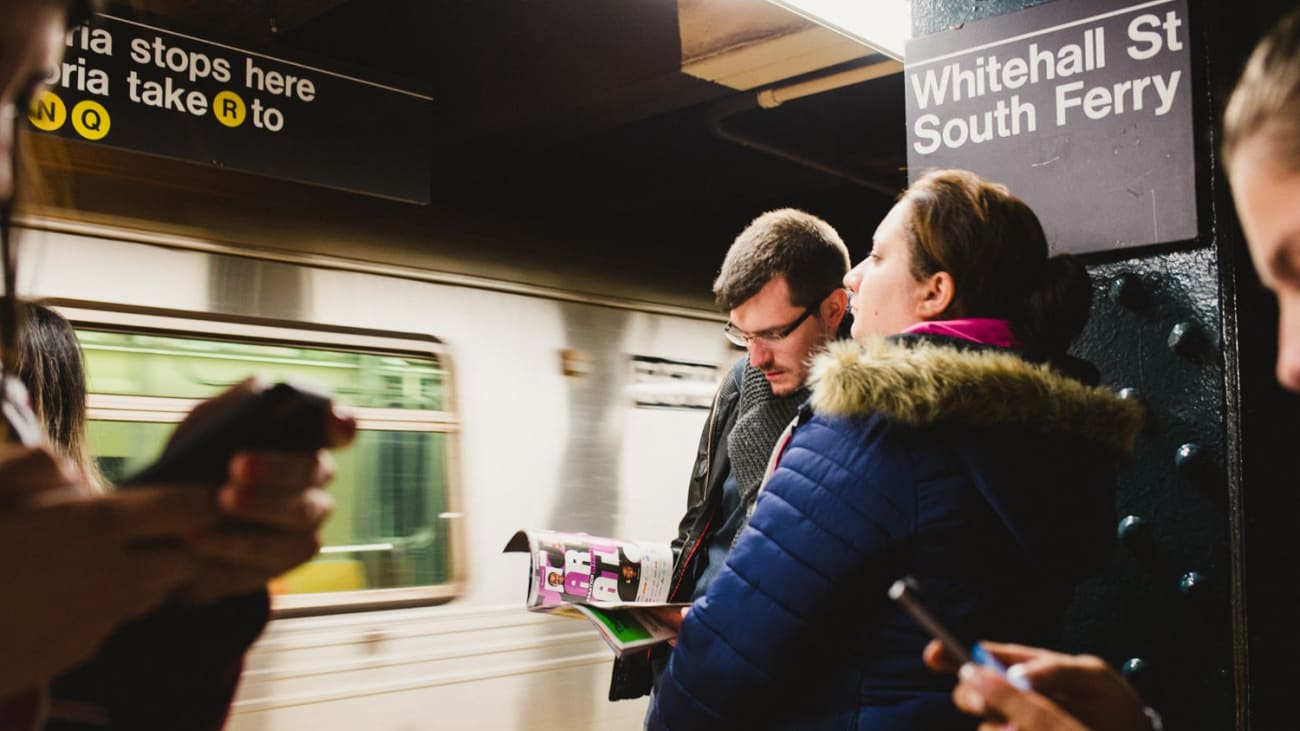
Image of the New York Underground | ©Hellotickets
If you're planning a trip to the Big Apple, transport is probably something you're concerned about if it's your first time using it, because with so many different lines, stations and types of underground, it's easy to get confused. Don't worry! In this guide to the New York underground, I'll tell you everything you need to know to get around like a true New Yorker.
How much does a ticket cost and how do I buy one? Are there travel cards?

** A single ticket on the New York subway costs USD 3 (around €2.60)**. If you plan to use public transport frequently for your journeys, the most convenient option today is to pay with OMNY (bank card, mobile phone or watch) or, if you prefer, with a rechargeable OMNY Card.
From 1 January 2026, you will no longer be able to purchase or top up a MetroCard. The MetroCard will continue to be accepted throughout 2026 (the exact end date will be announced at a later date). If you still have one from previous trips, you can use up the balance or transfer it to an OMNY Card at a Customer Service Centre.
Alternatively, you can also pay with OMNY, the contactless system that allows you to use your bank card, phone or smartwatch. With OMNY, there is a 7-day cap: on the underground and local/limited/SBS buses, you pay a maximum of £35 over a 7-day period (starting with your first tap). From then on, those journeys are free until the 7 days are up. Express buses and free transfers do not count towards this cap.
If you use express buses, there is a specific cap: you will not pay more than $67 for combined express + local bus + subway trips in any 7-day period.
How to get an OMNY Card?

- If you have a contactless bank card, mobile phone or watch, you can pay directly with OMNY (just tap the reader).
- If you prefer a physical card, purchase an OMNY Card.
- You can get an OMNY Card from OMNY vending machines in subway stations or at authorised points of sale.
- To take advantage of the weekly cap and transfers, try to always pay with the same method (same card/device).
How to use OMNY step by step
- On the subway: when entering, tap the OMNY reader on the turnstile with your bank card, mobile phone, watch or OMNY Card.
- On the bus: Tap the OMNY reader when boarding (on Select Bus Service, you can board through any door).
- To count transfers and the weekly cap, always use the same payment method.
- You have one free transfer within 2 hours: you can transfer from the underground to the bus, from the bus to the underground, or from bus to bus.
What you need to know if you still have a Metrocard

- What happens if I have both credit and unlimited rides on my card? If you have both credit and 7-day unlimited rides on your Metrocard, you will first use up the rides for that week and then begin to use the credit in dollars. In other words, unlimited rides take priority over credit for individual rides.
- Do children pay on the underground? Up to three children under 44" (111 cm) can travel for free as long as they are accompanied by an adult who is paying for their journey. On express buses, infants under two years of age travel for free if they sit on an adult's lap.
- How do you validate your Metrocard? It may seem obvious, but you need to swipe your card through the turnstile slot at a moderate speed so that the machine's reader can read the Metrocard properly. In other words, not too fast and not too slow.
- What happens if you take the wrong entrance and have to go back outside to find the correct station entrance? If you have chosen the unlimited travel Metrocard, you will have to wait at least 18 minutes to validate your card again at the turnstile. And if you have loaded the Metrocard with a balance in dollars, another £2.70 will be deducted from your balance. Unfortunately, you cannot request a refund for the incorrect journey.
- Can I buy the Metrocard before travelling to New York? No: as of 1 January 2026, you can no longer buy or top up the MetroCard. The normal way to pay is with OMNY (bank card, mobile phone or watch) or with an OMNY Card. If you still have an old MetroCard, you can transfer its balance to an OMNY Card at a Customer Service Centre.
- If I have questions about using it, will someone help me? You will find underground staff at many stations, but if there are none, don't worry, because New Yorkers are very helpful and will give you a hand if you need it.
- If I'm travelling to New York for two weeks, should I buy two cards? If you still have a pass/value on your MetroCard, you can use it. However, from 1 January 2026, it will no longer be possible to top it up: when it runs out, you will have to switch to OMNY (bank card, mobile phone or watch) or an OMNY Card.
- Can I share the MetroCard with someone else? If you choose the 7-day unlimited travel option, the card is for personal use only and is non-transferable. However, if you choose to load it with credit and pay for each journey, then you can share the MetroCard.
- What happens if I lose my Metrocard? The Pay-Per-Ride MetroCard cannot be replaced if you lose it or it is stolen (treat it like cash). However, the 30-Day Unlimited Ride MetroCard and the 7-Day Express Bus MetroCard can have balance protection if you purchased them with a card at a metro machine.
- How do I know how much balance I have left on my card? If you have been reloading your card with credit and don't know how much you have left, you can check at card readers in many underground stations, which will tell you your balance, how many days you have left and when your card expires.
- If I have a balance left on my card, will I get a refund? The remaining balance will be eligible for transfer or refund (as indicated by the MTA). In any case, each MetroCard has an expiry date (printed on the back) and is usually valid for about one year from the date of purchase. If it expires but you still have credit left, you can go to a Customer Service Centre to transfer the value to an OMNY Card.
- Can the MetroCard be used on other forms of transport? In addition to the New York subway network, this card can be used on the bus network and the Roosevelt Island Tramway. If you want to take a ferry, you will have to pay for a separate ticket, as it is not included in the MetroCard. If you would like to know more about the ferry, don't miss my practical guide to the New York ferry.
- If I have an unused MetroCard Unlimited, how long do I have to activate it? If you have a 7-Day or 30-Day Unlimited pass, the MTA states that you must start using it before 31 March 2026 to take advantage of all the days. If you start after that, you will have to request a pro-rated refund (in OMNY value) for the remaining days.
How to find your way around: express trains, line directions and the meaning of the letters

Once you have your ticket in hand, you'll need some guidance so you don't get lost in the largest underground system in the United States and one of the largest in the world. It has 472 stations on 25 routes, spread over 665 miles of track connecting Manhattan, the Bronx, Brooklyn and Queens. The only borough not served by the New York Underground is Staten Island. A very common way to get there is by the Staten Island Ferry, but it does not allow cars.
New York subway lines are identified by colours, and each line can be further divided into letters (A, B, C, etc.) and numbers (1, 2, 3, etc.) according to direction. To avoid getting lost, it is a good idea to follow these tips:
Be clear about where you are going
When taking the underground, be sure of the direction you want to go, as most lines branch off and trains take different directions. Once you know which line to take, go to the nearest underground station. All stations are marked withsigns indicating the entrance to the platforms heading south (Downtown and Brooklyn) or north (Uptown and Queens).
When boarding the underground, pay attention to the signs and signals. Both the signs and the public address system indicate the direction the train is going, showing the last stop on the route or which New York borough it is heading to.
Local trains vs. express trains: how to tell them apart
An important detail to note is that there are two types of trains in New York : local and express. Unlike local trains, express trains do not stop at every station and are much faster, making them very convenient for travelling long distances. It's fantastic because you can cross the city in less than 15 minutes!
Now, how do we know where an express or local train stops? Very easy, if you see a white circle on the map, it is an express train, if it has a black circle, then it is a local train.
Pay attention to the letters and numbers
Each line of the New York Underground has a different colour to identify it, but because they branch off at certain points on the map, to avoid the map becoming a multicoloured rainbow, each branch is given a different name with numbers and letters.
Therefore, when taking the Underground, you should refer not only to the colour of the line but also to the letters and numbers. In fact, New Yorkers are more familiar with the lines by their numbers and letters than by their colours.
And where can I see the letter or number of the underground train to know which one to get on? It appears on the first carriage of the underground train, although it is also displayed outside each carriage so that you can check it. Keep this in mind if you need to ask for directions or a route while underground.
Pay attention to the direction of the underground stations
As I said before, if you look at the New York underground map, you can see that there are underground lines that go in different directions when they branch off two or more times (such as the orange or yellow line).
The first thing you need to know before using it is to correctly distinguish between Uptown and Downtown. Sometimes, in the same underground station, the different entrances have different directions, i.e. on many streets, if you enter from one side of the pavement, you go south, and from the other, you go north.
Therefore, before going down to the underground, I advise you to check the direction so that you don't have to go back out onto the street and change direction, because in many cases, once you are inside the station, you cannot change platforms. The directions that the New York underground can take are: Downtown and Uptown (South and North) or Westbound and Eastbound (West and East). Sometimes you will also see signs indicating the district or neighbourhood to which they are travelling:
- Manhattan
- Queens
- Brooklyn
- Bronx
- Etc.
Transfer between lines?
Looking at the New York subway map, you might think that you can't transfer between lines unless they are marked as intersecting. But this is not always the case, as the map shows black lines that indicate the existence of transfer tunnels that make it easier to change lines and avoid unnecessary journeys.
Get your hands on a New York subway map
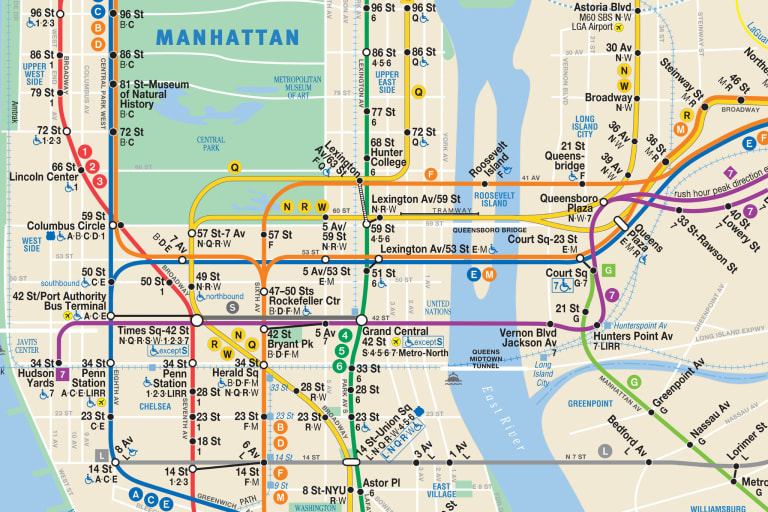
I suggest you download the New York subway map in PDF format to your phone. That way, you can always have it with you and consult it whenever you need to, even when you don't have an internet connection.
However, if you have data on your mobile phone, I recommend downloading an app in English with the official New York subway map, as you will not only find the map, but you will also be able to calculate the best route to take, the time until the next train arrives, and see any incidents on the lines, among other things. Here is an option for iOS and Android; if you prefer the official MTA tool, you can also use The Official MTA App.
What are the New York subway's hours and frequency?

The New York subway runs 24 hours a day, every day of the year, although some station entrances may be closed at night.
The frequency of trains varies depending on the line and the time of day:
- Rush hours: between 2 and 10 minutes, depending on the line.
- Midday and early evening: between 8 and 16 minutes.
- Night (early morning): approximately every 20 minutes.
As actual frequency varies by line and operating conditions, it is recommended that you check the official MTA app for real-time schedules and changes.
Tips for using the New York subway

The New York subway is not so different from other subways around the world in terms of rules of use. However, as a traveller, it is always a good idea to keep in mind some basic rules to make travelling on the transport network easier.
- In the carriages, always let people out before getting on.
- Do not block the carriagedoors with your luggage so that people can get on and off easily.
- When using escalators, if you are walking up or down, always use the left side. Otherwise, stand on the right side to facilitate the passage of other users.
- Give up your seat to people who may need it (the elderly, pregnant women, people with reduced mobility, etc.).
- Do not occupy other seats with your belongings. The seats are for the use of other passengers.
- Avoid eating or drinking inside the carriage during journeys out of respect for other passengers.
- In the underground or on the platforms, do not stare at people.
Explore New York's ghost subway station

The streets of New York are fascinating; there is always something new to discover in the city that never sleeps. There are countless tourist attractions above ground, but not many people know that beneath it lies a secret place known as the City Hall ghost subway station, which for a long time was shrouded in darkness.
Just its enigmatic name alone makes you want to find out what it's all about, right? To see it from the inside, the most reliable way is to sign up for a guided tour of the New York Transit Museum (Old City Hall Station tour), because the station is closed to the public.
If you just want to take a quick look, some trains on line 6 pass through the area when turning back at Brooklyn Bridge–City Hall, but you cannot get off at the closed station and sometimes you are asked to leave the train at the last stop.
Unfortunately, you cannot get off at the station to see it, but at least the underground runs at such a low speed that with a little skill you can take several photos of this little piece of New York history, which tells us about the origins of this public transport system at the beginning of the 20th century.
What is the ghost station of the New York Underground like?
City Hall was never a very popular station among New Yorkers, as most of them got on and off at the nearby Brooklyn Bridge. Over time and for various reasons, it was finally closed to the public in 1945. Perhaps this has allowed it to remain in such good condition, as have the original stained glass windows, chandeliers and glass panes that decorate it. In fact, many find it similar in style to the décor of Grand Central Terminal.
Another way to 'keep it on your radar' is from the surface: the station is under City Hall Park, but there is no free access to look around or go down.
The elegance and style of the design was striking. City Hall had stained glass windows that let in natural light and vaulted ceilings covered with tiles clearly influenced by Spanish architect Rafael Guastavino, whom the New York Times dubbed "the architect of New York" after his death for his famous "Guastavino tile" and his great contributions to American architectural design.
More things to do in New York!

But the ghost station of the New York subway is not the only secret place in the city. There are many original things to do and unique corners to explore! In the article 10 secret places and original things to do in New York that you can't miss, I tell you about some of them.
And if all that sightseeing makes you hungry, then I recommend you take a look at the article The 10 best places to eat in New York to find out where to treat yourself, or book a food tour in New York. You're here to enjoy yourself and have fun!