10 Things to Do at the Jewish Ghetto of Rome
Rome's Jewish quarter is one of the treasures of the Eternal City: here's how to discover it and what to do to get the most out of it.

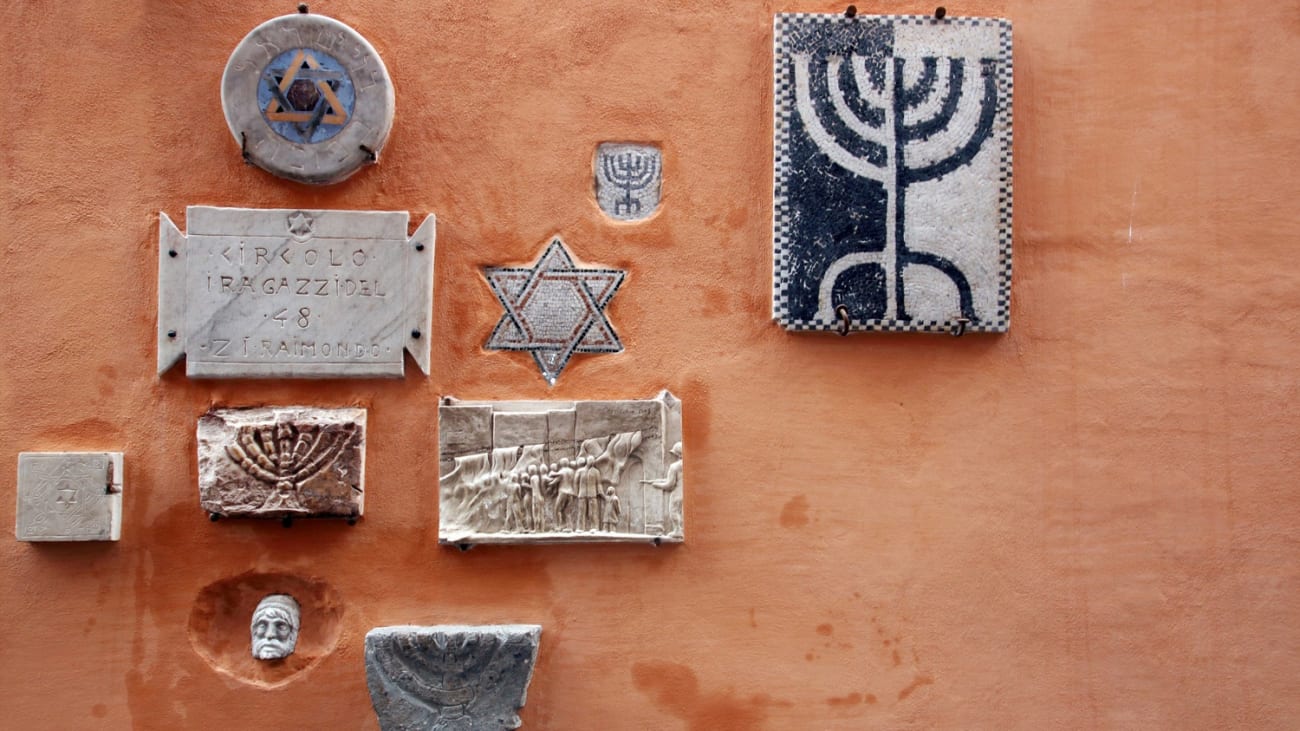
Hebrew symbols in Rome's Jewish quarter | ©Unsplash
Visiting Rome's Jewish ghetto or neighbourhood is one of the things you must do in Trastevere. Why? Because it is the oldest in Europe and throughout its history it grew to house a very important Jewish community.
Today, Rome's Jewish quarter is an area of boutiques, restaurants and kosher bakeries, and home to the city's synagogue. On every corner and in every nook and cranny, there is something to catch your eye, with ancient markets, fountains and theatres to discover on one of the best walks in all of Rome.
Here are all the places you can't miss in Rome's Jewish quarter:

Rome Trastevere and Jewish Ghetto Tour
Stroll around and discover Trastevere in great detail
Discover this picturesque neighbourhood in depth with an expert guide who will tell you all the interesting facts and information you need to know about this medieval neighbourhood.
With this tour of Trastevere and the Jewish quarter, you will have the opportunity to discover the oldest Jewish quarter in Europe and Trastevere with an expert guide who will tell you all about the history of its monuments, squares and points of interest. You will pass by the Basilica of Santa Cecilia in Trastevere, the Basilica of Santa Maria in Trastevere, Piazza Mattei and the Portico of Octavia.
A tour that will dazzle you and allow you to explore impressive restaurants and boutiques.
Recommended if: you want to get to know Trastevere in depth and not miss a single detail.
1. Tour Rome's Jewish quarter with an expert

An alternative to planning this tour yourself is to take a tour of Trastevere and the Jewish quarter, where you won't miss a single point of interest: the Portico of Octavia, the Theatre of Marcellus, the Turtle Fountain and the ruins of Torre Argentina, as well as places such as Piazza Farnese and the famous Basilica of Santa Maria in Trastevere.
For a very reasonable price, you'll get a tour lasting almost two hours; this is a great option if you're taking a shorter trip to Rome and don't have time to organise your visit, but don't want to miss out on the Jewish Quarter.
2. Cross over to Tiber Island, a place to enjoy the summer

If you are going on a tour of Trastevere and the Jewish quarter, I recommend that you take the opportunity to relax on Tiber Island, a great place to spend an afternoon in Rome. This boat-shaped island is located in the middle of the River Tiber and is connected to Trastevere and the Jewish quarter by two bridges, the Cestio and Fabricio bridges, one of the oldest in Rome. In the surrounding area, you will find cafés, restaurants, food stalls and an open-air cinema.
Tiber Island is a place that was historically avoided due to its dark legend and bad omens (it is said that the islet was formed by sediment accumulated on the corpse of Tarquinius Superbus, the last Etruscan king of Rome) and where a temple to the Roman god of medicine was built to stop the spread of the plague in the 3rd century. This is something I love about Rome: every place has a story you don't expect.
3. Admire the Portico of Octavia, a historic building

The Portico of Octavia, which you can see if you decide to take a tour of Trastevere and the Jewish quarter, is an ancient building constructed by Octavia Minor, sister of Emperor Augustus, which housed two temples dedicated to Jupiter and Juno, as well as a library and a school. It is located in the rione of Sant'Angelo, considered the main street of Rome's Jewish quarter, and what today looks like a ruin is actually a building steeped in history.
The adjoining church was where sermons were given, which the Jewish community in the neighbourhood was obliged to attend until freedom of worship was decreed in Rome in the 18th century.
4. Stop by the Teatro Marcello, the Colosseum's little brother

If, when you see this building, you can't help thinking about your visit to the Colosseum, you should know that the Teatro Marcello was something of a blueprint for Rome's most important building. It is an open-air theatre from the time of Augustus, where musical and theatrical performances were held.
Today, the theatre houses an old palace converted into private residences, and popular shows are still held in the surrounding area, especially in summer. If you are travelling to Rome during the summer season and are going to take a tour of Trastevere and the Jewish Quarter, I recommend you visit the area as the lighting is usually very special at nightfall.
5. Try typical local dishes

If you want to maximise your experience, you can take a food tour of Trastevere, Campo dei Fori and the Jewish Ghetto, or make your own reservations at a restaurant or café if you plan to have lunch or dinner in the Trastevere area. Many restaurants are closed on Friday evenings or even Saturdays, so I recommend visiting the Jewish Quarter during the week.
As in the rest of Rome, there are restaurants in the Jewish Quarter designed for tourists that I recommend avoiding at all costs, and the really good ones fill up quickly, so I recommend booking a table in advance.
6. See the Turtle Fountain, one of the most curious fountains in Rome

From Via d'Ottavia, where the portico is located, you will reach Via di Sant'Ambrogio and from there to Piazza Mattei, places that are included in the tour of Trastevere and the Jewish quarter. There you will find the Turtle Fountain, one of the most curious in Rome, and in its surroundings you can see fragments of the history of the people who lived in this neighbourhood, with golden plaques commemorating the Jews who were murdered in concentration camps.
It is here that you realise that the bustling days that filled the neighbourhood with life ended in 1943, when in a single day, nearly 2,000 of the 7,000 people who were part of Rome's Jewish community were forcibly taken away. What remains today is only a memory of a bygone era.
Before continuing your walk, I recommend sitting in Piazza Mattei to watch the people go by and try to imagine what this neighbourhood was like in the last century.
7. Visit the Synagogue in the Jewish Quarter

The synagogue in Rome is one of the largest in Europe and was built to commemorate the moment when Jews in Italy were granted citizenship.
Its square dome distinguishes it from any other religious building in Rome, and the Art Nouveau decorations on its exterior make it a distinguished and beautiful temple, especially when the sun shines on its columns and stained-glass windows.
If you are fortunate on your tour of Trastevere and the Jewish quarter, you will pass by the synagogue in the Jewish quarter when music is being played on its impressive organ inside. If you have time to spare, I recommend going in and admiring the colourful interior of the building, which you can only do on a guided tour through the entrance to the Jewish Museum.
8. Stroll through Largo di Torre Argentina, the site of Julius Caesar's death

To finish your tour of Rome's Jewish quarter, you will find Largo di Torre Argentina square to the north. Here you can see ruins from the Republican era: four Roman temples and what remains of the ancient Theatre of Pompey.
Emperor Augustus ordered the construction of a monument to commemorate the site of Julius Caesar's assassination while presiding over the Senate meeting in Pompey's Curia. Today, you can see the ruins of this building at the Torre Argentina archaeological site.
And if you love cats, this place will become one of your favourites in Rome because of the shelter for abandoned cats in the area. You will see them walking and playing among the ruins, giving Torre Argentina a mystical and somewhat surreal aura.
9. Try the sweets at Pasticceria Boccione

In the narrow streets of the Jewish quarter, you'll find more than one local shop selling typical Jewish products, but my favourite is definitely Pasticceria Boccione. From the outside, its small shop window may not catch your eye, but I assure you it's worth going in and choosing one (or several) of its delicacies.
It's ideal for a snack if you're walking around the area and want to satisfy your appetite between meals. You'll find it on Via del Portico d'Ottavia.
10. Visit the surroundings of the Jewish quarter

Strolling through Rome's Jewish quarter is one of the things to do in Trastevere, and what better way than with a guided tour. It is close to Piazza Venezia and Piazza del Campidoglio, so adding a visit to the Capitoline Museums to your day can be a perfect way to round off the day. If you want to read more about this experience, I have written a guide that you may find useful: Capitoline Museums in Rome: Tickets and Tours
How to prepare for a visit to Rome's Jewish quarter
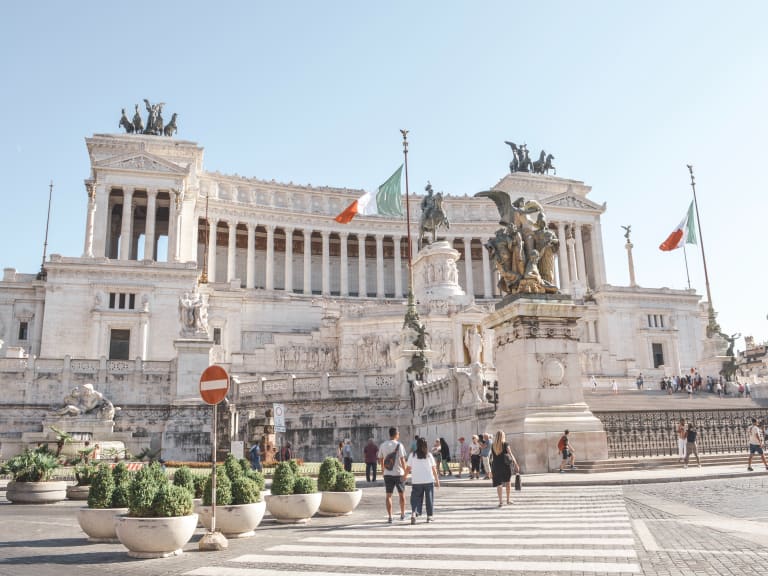
Now you know what to see in Rome's Jewish quarter, you just need to know how. Keep reading and I'll share all the tips you need to enjoy the experience to the fullest and have a wonderful afternoon in this part of the city.
Where is Rome's Jewish quarter?
The good thing about the Jewish quarter is that it's actually part of central Rome, even though it seems like a separate area that you need to prepare for and set aside a whole day to visit. Nothing could be further from the truth: the easiest way to start exploring the Jewish quarter is to go to Piazza Venezia or the Vittorio Emanuele monument. The Jewish ghetto is the area to the south-west of this location, bounded by Via delle Botteghe Oscure (to the north), the river (to the south), Via del Teatro di Marcello (to the east) and Via Arenula (to the west).
How long does it take to visit Rome's Jewish quarter?
It took me about three hours to complete the itinerary I have outlined in this article. Considering how much I stopped to admire details, get a little lost and explore whatever caught my attention along the way, I would say that you can even visit Rome's Jewish quarter in an hour and a half or two hours.
My recommendation, especially if you go in summer, is to set aside an afternoon to stroll around here, have a drink in the Tiber Island area and sit down to enjoy the sunset reflecting on the river. This, of course, changes if you decide to book a guided tour of this area, as this experience will take you on a slightly different and shorter route.