


More about: 10 Best Artworks of the Rome Capitoline Museums
Since Pope Sixtus IV donated a collection of bronze sculptures to the Capitoline Museums in Rome in the 15th century, the collection has continued to grow, making it the city's main municipal museum and an essential place to visit during a trip to the Italian capital.
There is so much to see within its walls. Authentic artistic treasures from different periods, which I will give you a sneak preview of in this post to help you contextualise what you will discover once you are there. Oh, and don't forget to check out the ticket prices and opening hours of the Capitoline Museums so you can plan your visit in detail.
1. The Capitoline Wolf
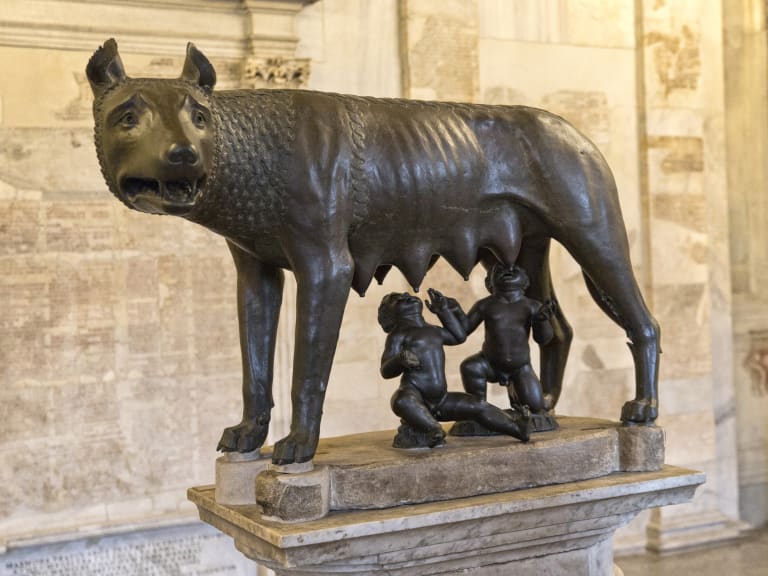
In the centre of the Hall of the She-Wolf in the Capitoline Museums is the statue of the Capitoline She-Wolf, the symbol of Rome.
Legend has it that this she-wolf found the twins Romulus and Remus in the waters of the Tiber, near the Palatine Hill, and cared for and suckled them as if they were her own children. The two would later become the founders of the city, although many theories claim that this myth is merely an invention of the Romans to shroud the birth of the imperial city in epic glory.
The statue of the Capitoline Wolf dates from the 11th or 12th century and is made of bronze. It is believed to be a copy of an Etruscan statue that played a sacred role in ancient Rome. The two small figures of Romulus and Remus accompanying Luperca, on the other hand, were added to the ensemble later, towards the end of the 15th century.
As a curiosity, in the Piazza del Campidoglio (from whose viewpoint there is one of the best views of Rome) there is a replica of the Capitoline Wolf that also attracts a lot of attention. Don't forget to take a photo!
2. The Equestrian Statue of Marcus Aurelius

During the Roman Empire, equestrian statues were very common in the city, but what makes Marcus Aurelius' statue special is that it is the only equestrian statue from Antiquity that survived the Middle Ages. During this period, most of these works of art were melted down to mint coins with their bronze.
The equestrian statue of Marcus Aurelius has survived to this day because it was mistaken for Emperor Constantine I, who, through the Edict of Milan, stopped the persecution of Christians and granted freedom of worship in the Empire.
The statue is currently located in the Palazzo dei Conservatori in the Capitoline Museums, and there is some debate as to its original location. The most likely locations seem to be the Roman Forum or Piazza Colonna (where the Antonine Column stood) and not near the Basilica of St. John Lateran, as medieval sources from the 10th century attest.
You can see a replica of this 2nd-century bronze statue in Piazza del Campidoglio, where Michelangelo placed the original in the 16th century.
3. The Dying Galatian

Along with the above, the statue of the Dying Galatian is one of the most popular in the Capitoline Museums, as it shows with great realism the pain of a Gaul defeated in battle by King Attalus I of Pergamon, who fights against death and refuses to give in to his fate.
This work is believed to be a Roman marble copy of an earlier Hellenistic work in bronze, which belongs to the Pergamon School, which used to delve into the expression of pathos. Its artistic quality made it one of the works of antiquity most admired by European travellers on the Grand Tour.
It seems that the statue of the Dying Galatian was discovered during excavations at Villa Ludovisi in the early 17th century, together with the statue of the Galatian committing suicide (on display in the Altemps Palace of the National Roman Museum), as both were part of a sculptural group of four figures.
4. The Capitoline Venus

The Capitoline Venus is another of the most popular statues in the Capitoline Museums. You will find it in the so-called "Cabinet of Venus" on the ground floor of the Palazzo Nuovo del Campidoglio.
This sculpture is a replica of a Hellenistic statue created by Praxiteles in the 4th century BC. It was found near the Basilica of San Vitale in the 17th century and Pope Benedict XIV bought it from the Stazi family to donate it to the Capitoline Museums.
It depicts the goddess Venus emerging naked from her bath, in a contemplative pose, and has been the subject of numerous replicas known as the 'Capitoline Venuses'.
5. The head of the colossal statue of Constantine

In the same room of the Palazzo dei Conservatori where the equestrian statue of Marcus Aurelius is located, you can also see the head of the colossal statue of Constantine, which was part of a seated statue of the emperor dating from the 3rd century AD. Other parts of the statue are still preserved and can also be seen during a visit to the Capitoline Museums.
The remains of the colossal statue of Constantine were found in the Basilica of Maxentius in the Roman Forum in the 15th century.
6. The Spinario
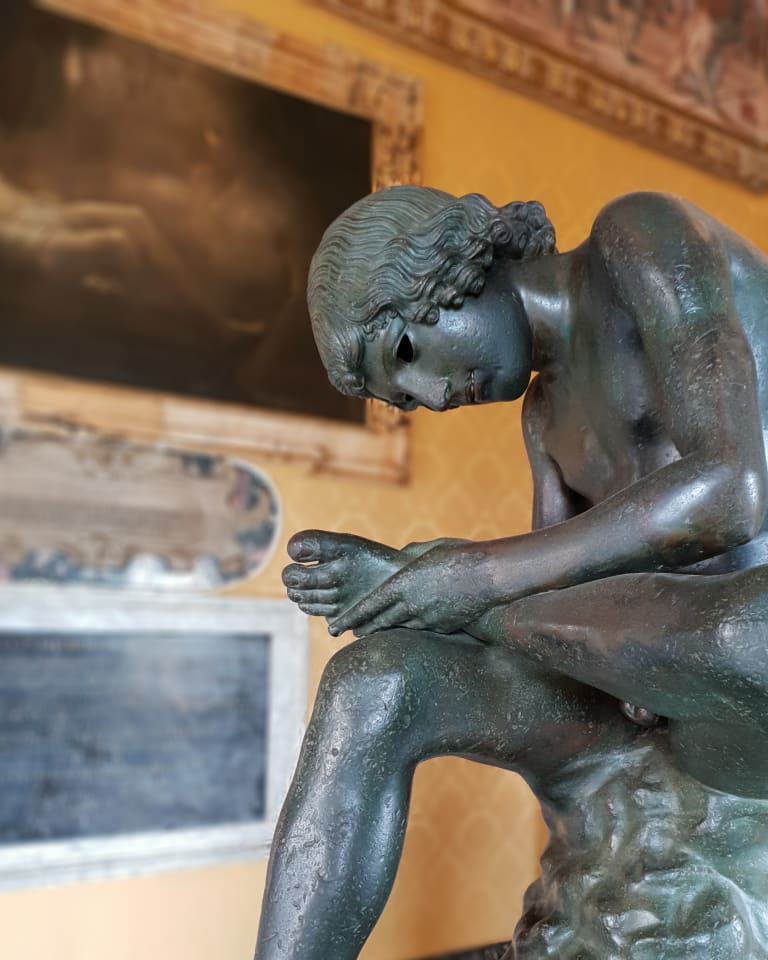
This bronze sculpture from the 1st century BC is another of the most popular works in the Capitoline Museums due to its unique pose and unusual subject matter. In fact, during the Renaissance it became highly prized and gave rise to several replicas, such as those on display in the Louvre Museum in Paris and the Pushkin Museum in Moscow.
The Espinario depicts a seated boy looking at the sole of his left foot to remove a thorn that has become lodged there.
7. The Bust of Medusa

In Greek mythology, Medusa was a woman with snake hair who had the power to petrify anyone who dared to look her in the eye.
This bust is a work by Gian Lorenzo Bernini from the 17th century that depicts the exact moment of metamorphosis. The artist's intention with this sculpture was to showcase his talent as a sculptor while also playing with the viewer, who can be "turned to stone" like Medusa when admiring his skills with the chisel.
You will find this work of art on display in the Palazzo dei Conservatori in the Capitoline Museums.
8. The Marforio
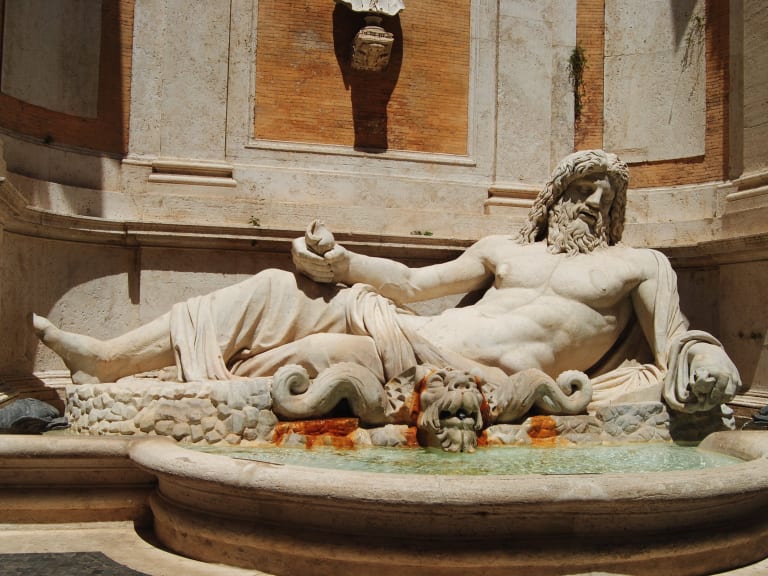
Another of the most famous works of art in the Capitoline Museums is the Marforio, a colossal marble sculpture dating from the 1st century AD, which originally adorned a Roman fountain from the Flavian period.
It represents the personification of an ocean or river and was found in the 16th century in the Forum of Augustus, next to the temple of Mars Ultor. Today, it can be seen in the courtyard of the Palazzo Nuovo.
9. The Mosaic of the Doves
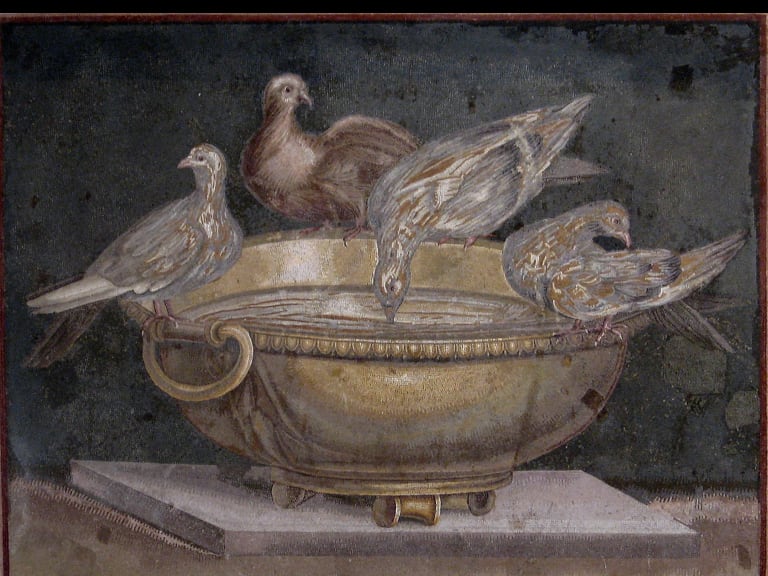
This fantastic 2nd-century mosaic, found in Hadrian's Villa in Tivoli during the 18th century, is believed to be a Hellenistic copy of the work that Soso of Pergamon created to decorate the palace of King Eumenes II of Pergamon.
The Mosaic of the Doves is an excellent example of the degree of skill achieved by mosaic artists in Rome, creating highly realistic effects using only glass and marble tesserae.
You can see this work in the Hall of the Doves. There you will also have the opportunity to see other interesting finds such as other mosaics, bas-reliefs and some bronze tablets with engraved laws.
10. Caravaggio's Buonaventura

Finally, in the Santa Petronilla room, you can see the canvas of La Buenaventura, one of the first works by the painter Caravaggio, which was quite revolutionary for the late 16th century as it broke away from the dominant historical framework of the time (where biblical and mythological themes abounded) to focus on the daily life of the people of that time.
La Buenaventura depicts a gypsy girl predicting the future to a naive young man, from whom she also steals a ring from his hand, taking advantage of the fact that he is distracted by her smile.
In addition to its unusual subject matter, this work caused a stir among the aesthetes of the time. The reason? Look at the girl's hands, which Caravaggio depicted as dirty, reflecting the poor hygiene of the working classes at that time.
As I said, this did not go down well with aesthetes, who made no concessions to everyday life in their paintings, but insisted that beauty should be prioritised and elevated above social issues in art.